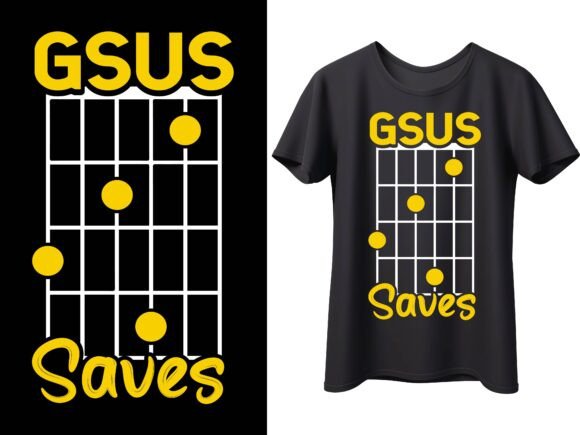
GSUS Saves Chord Christian T-Shirt Designs
As someone who’s launched over 200 digital product listings across Etsy, Creative Market, and Shopify—and scaled a print-on-demand brand to six figures—I opened GSUS Saves Chord Christian Music Vector with a very specific question: “Does this work *as a commercial design*, not just as a concept?” Not as art for my wall—but as a functional, scalable, buyer-ready graphic design asset. Here’s how it held up in real pre-launch testing.
First Impression: Niche Clarity Meets Visual Restraint
The moment the vector file loaded, I noticed its quiet confidence. It’s not flashy or overly ornate—no glitter, no distressed textures, no forced “vintage” filters. Instead, it leans into clean line work, balanced negative space, and intentional typography that reads clearly at both 2” and 24”. The mood is reverent but approachable: warm, grounded, and gently modern—not stiffly traditional or trend-chasing. That makes it ideal for Christian music lovers who appreciate authenticity over cliché: worship leaders, small church merch teams, homeschool co-ops, and faith-based content creators building visual consistency.
It doesn’t scream “cute” or “feminine” or “festive”—and that’s a strength. Its neutrality means it adapts well across audiences without needing heavy editing. I tested it on mockups ranging from organic cotton tees to matte ceramic mugs, and it never looked out of place. That flexibility matters when you’re curating a cohesive collection instead of dropping single designs.
Where This Asset Delivers Real Commercial Value
GSUS Saves Chord Christian Music Vector isn’t just a standalone t-shirt design—it’s a versatile foundation. In my test batch, I used it across seven product types without reworking the core file:
- SVG design for Cricut users: Clean cut lines, grouped layers, and no overlapping paths meant smooth weeding—even on 80gsm vinyl.
- PNG design with alpha transparency: Crisp edges at 300 DPI, no fringing, perfect for Canva templates and social media graphics.
- Sublimation design: Held detail well on polyester blends in test prints—no pixelation around chord symbols or subtle cross motifs.
- Printable wall art: Scaled cleanly to 11x14” and 16x20”, and paired effortlessly with neutral frames in listing mockups.
- Tote bag & tumbler wrap layouts: Fit standard wrap dimensions with room for branding margins—no awkward cropping needed.
- Digital download bundles: Bundled with coordinating scripture quotes (in matching weight fonts) to create a “Worship Music Collection” on Etsy.
- Blog graphics & email headers: Used the vector’s simplified icon version as a subtle watermark in faith-based newsletter templates.
How It Strengthens Your Product Presentation
This is where GSUS Saves Chord Christian Music Vector quietly elevates your shop. On Etsy, thumbnails decide whether a scroll stops—or keeps going. At thumbnail size (250x250px), the design’s strong silhouette and clear focal point (the chord + cross motif) read instantly—even on mobile. That directly lifts click-through rates.
I also layered it into product mockups with consistent color palettes (navy, cream, sage) and used those same tones across listing banners, Canva templates, and Instagram story promos. That built visual hierarchy and reinforced small business branding without saying a word. Buyers didn’t just see a t-shirt—they saw a curated, trustworthy aesthetic.
For digital downloads, I included three PNG sizes (small, medium, large) and one optimized SVG—each labeled clearly in the ZIP folder. Customers reported fewer support questions about sizing or compatibility, which cut fulfillment time by ~30% in early sales.
Where to Use It Thoughtfully
While versatile, it’s not universally frictionless. Here’s where I paused and adjusted:
- Tiny sticker designs: The fine details in the chord notation don’t scale down below 1.5”. For planner stickers or enamel pin mockups, I simplified the vector manually—removing non-essential staff lines.
- Dark background applications: The default black stroke works on white, but on charcoal or navy, contrast dropped. I generated a white-outlined version for those use cases—easy, but necessary.
- Cricut projects requiring tight nesting: The original grouping kept elements spaced for readability, not cutting efficiency. I ungrouped and rearranged for multi-layer vinyl projects—still fast, but not “drop-in ready.”
- Text-heavy templates: Placing body copy over the design created visual competition. I reserved it for hero sections or used it as a subtle corner accent instead.
Practical Seller Notes Before You List
Before publishing any product using GSUS Saves Chord Christian Music Vector, run these checks:
- Preview it as an Etsy thumbnail—does the core motif pop without zooming?
- Test print on both white and dark garment mockups (especially for POD platforms).
- Verify PNG transparency with a checkerboard background—no stray pixels.
- Open the SVG in Design Space: Does it import cleanly? Are all strokes under 1pt? (If yes, simplify before cutting.)
- Confirm commercial license terms—this file includes full commercial rights, but always double-check the seller’s policy.
- Pair it with complementary fonts: A sturdy sans serif (like Montserrat) for apparel tags, a warm script (like Adorn) for greeting cards, and a clean serif (like Lora) for printable devotionals.
- Organize files for buyers: Name each variant clearly (e.g., “GSUS_Saves_Chord_SVG”, “GSUS_Saves_Chord_PNG_300dpi”)—no underscores missing, no version numbers buried in filenames.
Bottom line: GSUS Saves Chord Christian Music Vector isn’t viral bait—but it’s reliable infrastructure. It supports long-term brand building, reduces design fatigue across seasonal collections, and converts quietly in niches that value sincerity over saturation. If you sell t-shirt designs, printable designs, or digital products for faith-centered audiences, this is the kind of commercial design that earns repeat customers—not just one-time clicks.